Thematic Dossier: Reenactment studies in the performing arts
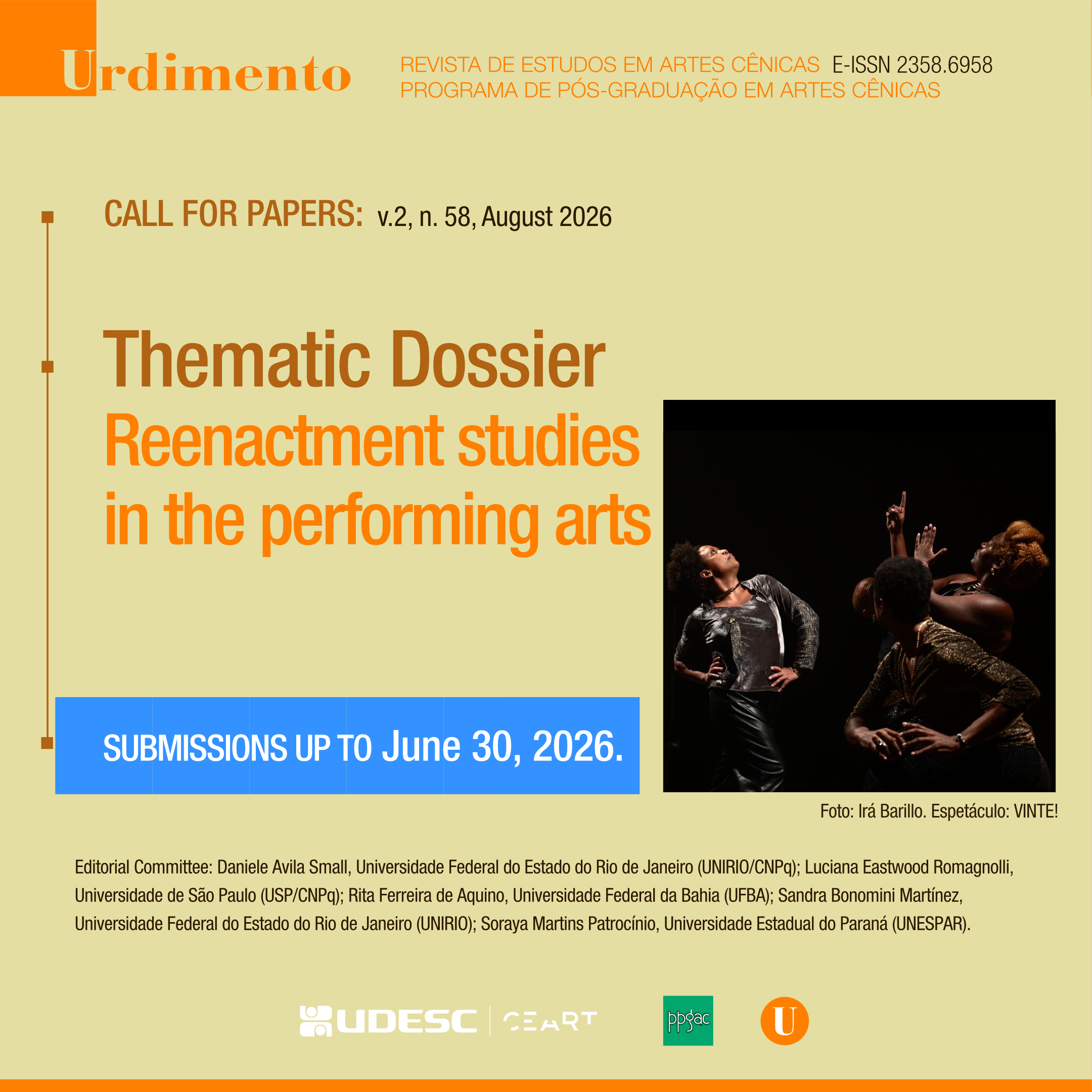
The Editorial Committee proposing this Thematic Dossier is composed of the following professors: Daniele Avila Small, Universidade Federal do Estado do Rio de Janeiro (UNIRIO/UNPq - coordinator) y compost for: Luciana Eastwood Romagnolli, Universidade de São Paulo (USP/CNPq); Rita Ferreira de Aquino, Universidade Federal da Bahia (UFBA); Sandra Bonomini Martínez, Universidade Federal do Estado do Rio de Janeiro (UNIRIO); Soraya Martins Patrocínio, Universidade Estadual do Paraná (UNESPAR).
Dossier proposal:
In recent decades, reenactment studies have emerged as an autonomous and expanding field, in close dialogue with performance studies. As a complex phenomenon within the performing arts, reenactments challenge conventional notions of history, memory, and archive. Far from being a mere preservation of ephemeral repertoires, this practice engages with the reconfiguration of temporalities, the problematization of presence, authenticity, and other values of modernity in the arts, as well as the investigation of the body as a producer of knowledge. This dossier, therefore, aims to explore the multifaceted possibilities of reenactment in its theoretical, aesthetic, and political manifestations within the performing arts.
By delving into the conceptual, methodological, and ethical dimensions of this field, this thematic dossier aims to foster an in-depth debate on how reenactment contributes to a broadening of the critical perspective on artistic practice, a reflexive engagement with the past, and movements to revise the historiography of the arts and cultural memory. We invite researchers and artists to submit articles that explore the various forms and impacts of reenactment in theatre, dance, performance art, and circus, as well as in other interdisciplinary scenic expressions. Submissions should aim to deepen the understanding of the relationship between art, history, and society.
Suggestions for approaches:
- Reenactment and the body as document: Exploring the materialities of memory on stage, the performativity of gesture, and phenomenological engagement with the archive.
- Ethical dilemmas and politics of reenactment: Analyzing the ethical implications of reenacting traumatic events, historical facts, and testimonies, including questions of representation, authorship, and appropriation.
- Anachronistic temporalities: How reenactment destabilizes temporal linearity, creating frictions and coexistences between past, present, and future in performances.
- Reenactment and Remediation: Critical-creative perspectives on the interactions between analog and digital technologies in reenactments, including digital theater, re-creations via digital media, and virtual reality.
- Reenactment as a political gesture: Exploring its role as a tool of resistance, social criticism, and activism, particularly in contexts of peripheral memories, silenced histories, and decoloniality.
- Reenactment methodologies on the contemporary stage: Examining research, creation, and rehearsal processes in reenactment projects; technologies for activating embodied knowledge in training programs; and methods for arts creation and pedagogy.
- A psychoanalytic perspective on the reenactment scene.
- Reenactment in dance: Exploring how reenactments have been and are currently developed in choreographic practices, the recreation of historical works, and embodied modes of performance telling.
- Reenactment and decoloniality: Questioning Eurocentric approaches to reenactment, and exploring practices of repetition, memory, and ritual in Indigenous, Afro-diasporic, and other non-Western cosmologies.
- Non-hegemonic bibliographies in reenactment studies: Analyzing intellectual production for the field developed in Brazil, other Latin American countries, and other regions of the Global South.
In addition to articles, the dossier will include submissions in the following formats: reports, debates and dramaturgy.
All submitted articles are evaluated using a double-blind system (peer review); publication will occur after approval by two ad hoc reviewers.
To publish in Urdimento n.58, the interested party must first register as an author at the link: http://www.revistas.udesc.br/index.php/urdimento/user/register
Then, the article must be submitted to the OJS platform at the URDIMENTO link by June 30, 2026: http://www.revistas.udesc.br/index.php/urdimento
Articles must be submitted in accordance with the Guidelines for Authors, at the link:
http://www.revistas.udesc.br/index.php/urdimento/about/submissions