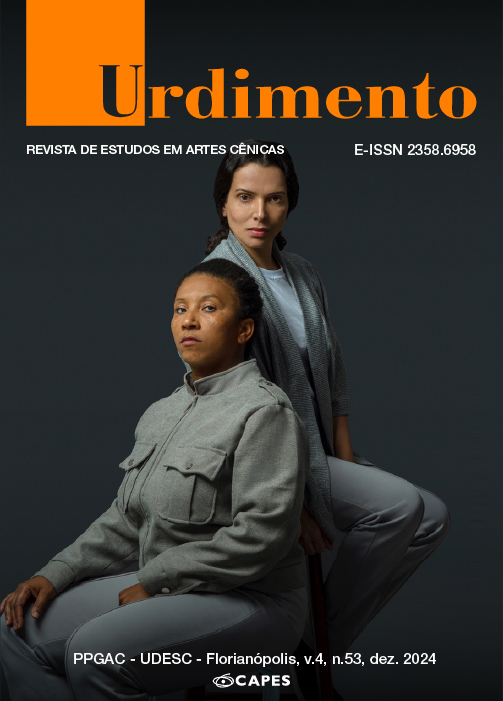
Feather/Pity: possible ballet as poetic unfolding
DOI:
https://doi.org/10.5965/1414573104532024e204Keywords:
ballet, disability, creation, dance researchAbstract
This is a report on a trajectory that includes studies and professional performance at an international level. By addressing the relationship between classical dance, disability and poetics from the occurrence of a stroke. One arrives at the exposition of Possible Ballet, an investigation in the form of a post-doctorate that took practice based research for the methodological bias. A body practice proposal based on the principles of ballet movement in order to arrive at processes of scenic creation through improvisation. The creation of the work Feather/Pity is addressed, which brought up issues found in current authors who write about dance and disability, ballet technique and creation.
Downloads
References
ALTEN, Anna. Ballet in transition: why classical ballet technique is no longer sacrosanct. In: Brown, Derrick (Org.), Ballet, Why and How?: on the role of classical ballet in dance education. Arnhem: ArtEZ Press, 2014, p. 447-52.
ALBRIGHT, Ann Cooper. Strategic abilities: negotiating the disabled body in dance, In: Dils, Ann & Albright, Ann Cooper (Ed) Moving history/dance cultures: a dance history reader. Middletown: Wesleyan University Press, 2001, p. 56-66.
ALBRIGHT, Ann Cooper. Choreographing Difference: the body and identity in contemporary dance. Middletown: Wesleyan University Press, 1997.
ALTEROWITZ, Gretchen. Contemporary Ballet: Inhabiting the Past While Engaging the Future. In: Farrugia-kriel, K e jensen, J. N. (ed), Conversations across the field of dance studies: Network of Pointes. Society of Dance History Scholars, 2015, vol. XXXV, p. 20-23.
BRESNAHAN, Aili and DECKARD, Michael. Beauty in Disability: An Aesthetics for Dance and for Life. In: In Karen Bond (ed.) Dance and Quality of Life, Social Indicators research series. Netherlands: Springer, Vol. 73, 2019, p. 185-206.
CLEMENTS, Lucie & NORDIN-BATES, Sanna M. Inspired or Inhibited? Choreographers’ Views on How Classical Ballet Training Shaped Their Creativity, Journal of Dance Education, Taylor & Francis 22:1, 2022, p. 1-12.
FARRUGIA-KRIEL, Kathrina & JENSEN, Jill Nunes (ed). The Oxford Handbook of Contemporary Ballet Nova Iorque: Oxford University Press, 2021.
FARRUGIA-KRIEL, Kathrina & JENSEN, Jill Nunes. Conversations across the field of dance studies: Network of Pointes. Society of Dance History Scholars, 2015, vol. XXXV.
FORTIN, Sylvie. Educação Somática: novo ingrediente da formação prática em dança, In: Cadernos do Cepe-Cit Salvador: UFBA, n, 2, p.40-55, 1999.
HOMANS, Jennifer. Apollo’s angels: A history of ballet. Nova Iorque: Random House, 2010.
JACKSON, Jennifer. My dance and the ideal body: looking at ballet practice from the inside out, Research in Dance Education. Taylor & Francis, 6(1-2), 2005, p. 25-40.
KUPPERS, Petra. Accessible Education: Aesthetics, bodies and disability, Research in Dance Education. Taylor & Francis, 1:2, 2010, p. 119-131. Disponível em: https://www.tandfonline.com/doi/abs/10.1080/713694266 Acesso em: 20 out. 2024.
MIDGELOW, Vida L. Reworking the ballet: counter-narratives and alternative bodies. Nova Iorque: Routledge, 2007.
MONTEIRO, Mariana. Balé, tradição e ruptura. In: Pereira, R., Soter, S. & Aragão, V. (org.), Lições de dança 1. Rio de Janeiro: UniverCidade, 1999, p. 169-190.
MORRIS, Geraldine. Problems with Ballet: Steps, style and training, Research in Dance Education. Taylor & Francis 4:1, 2010, p. 17-30. Disponível em: https://www.tandfonline.com/doi/abs/10.1080/14647890308308 Acesso em: 20 out. 2024.
RITENBURG, Heather Margaret. Frozen landscapes: a Foucauldian genealogy of the ideal ballet dancer’s body, Research in Dance Education. Taylor & Francis, 11:1, 2010, p. 71-85.
RODRIGUES, Graziela Estela Fonseca; et al. Corpos em Expansão: a arte do encontro no método Bailarino- Pesquisador-Intérprete (BPI). Revista Brasileira de Estudos da Presença, Porto Alegre, v. 6, n. 3, p. 551–577, 2016. Disponível em: https://seer.ufrgs.br/index.php/presenca/article/view/65010. Acesso em: 20 set. 2024.
RODRIGUES, Graziela Estela Fonseca. As Ferramentas do BPI (Bailarino-Pesquisador-Intérprete). In: I Simpósio internacional e congresso brasileiro de imagem corporal, 2010, Anais do I Simpósio Internacional e Congresso Brasileiro de imagem Corporal. Campinas, 2010, p 1-4. Disponível em:http://www.fef.unicamp.br/fef/sites/uploads/congressos/imagemcorporal2010/trabalhos/portugues/area3/IC3-28.pdf Acesso em: 20 set. 2024.
STANTON, E. Doing, re-doing and undoing: practice, repetition and critical evaluation as mechanisms for learning in a dance technique class ‘laboratory’, Theatre, Dance and Performance Training. Taylor & Francis, 2:1, 2011, p. 86-98.
TEIXEIRA, Carolina. Deficiência em cena. João Pessoa: Ideia, 2011.
Published
Issue
Section
License
Copyright (c) 2024 Urdimento: Revista de Estudos em Artes Cênicas

This work is licensed under a Creative Commons Attribution 4.0 International License.
Copyright Statement
The articles published by the magazine are free to use. The copyright is all assigned to the magazine. The articles whose authors are identified represent the expression from the point of view of their authors and not the official position of the journal Urdimento. The author (s) undertakes whenever publishing material relating to the article published in Revista Urdimento mention the said publication as follows: This article was originally published by Urdimento magazine in its volume (put the volume), number (put the number) in the year of (put the year) and can be accessed at:
http://www.revistas.udesc.br/index.php/urdimento
This work is licensed under a Creative Commons Attribution 4.0 International License.